ETP-G Method | Achieving Zero Residual Soil and High Load-Bearing Capacity with Rotational Driven Steel Pipe Piles
Ground reinforcement work

Reduce soil disposal costs! The ETP-G method, which demonstrates powerful tip support strength with enlarged wings and excavation auxiliary bits, utilizes rotary penetration without cement.
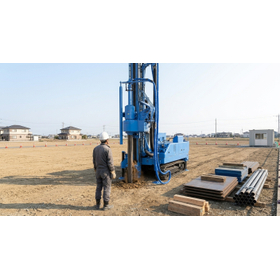
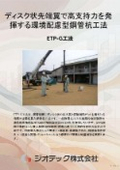
The ETP-G method reduces disposal costs with zero residual soil while ensuring powerful advanced support strength. Geotech's rotary-driven steel pipe piles are an advanced method equipped with disc-shaped enlarged wings and triangular excavation auxiliary bits at the ends of the steel pipes. Its unique structure suppresses axial deviation, achieving both high propulsion force and high support strength. Since it does not use cement solidifiers, there is no excavation residual soil, eliminating the risk of environmental pollution. It enables clean construction with low noise and low vibration. It is suitable for small buildings with three stories or less and a total floor area of 1,500 square meters or less, as well as retaining walls, and optimal designs can be achieved with seven types of pile diameters and 45 types of wing diameters. Under a quality management system compliant with ISO certification, safety is ensured through thorough management from investigation to construction.

Inquire About This Product
basic information
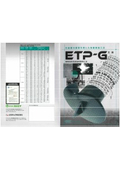
The main specifications of the ETP-G method include seven types of shaft steel pipes with an outer diameter ranging from φ89.1mm to φ216.3mm, a wall thickness of 3.2mm to 12.7mm, and materials of STK400 and STK490. The enlarged base wings use materials such as SM490A with diameters ranging from 223mm to 620mm and thicknesses from 12mm to 22mm, boasting a rich variety of 45 types. The maximum construction depth can accommodate up to 130 times the pile diameter and up to 19.2m from the ground surface of the reinforced material. Applicable ground types include sandy soil (including gravel soil) and clay soil, with rational bearing capacity calculation formulas established through SWS and SRS tests.
Price information
Delivery Time
Applications/Examples of results
This construction method is ideal for small buildings with three stories or fewer, a height of 13 meters or less, and a total floor area of 1,500 square meters or less (for single-story buildings, up to 3,000 square meters). It is also widely used for foundation reinforcement of retaining walls under 3.5 meters in height, as well as structures like septic tanks and billboards. Since it employs a rotary insertion method that does not use cement solidifiers, it is suitable for sites looking to reduce soil disposal costs and for environmentally conscious projects aiming to prevent soil and groundwater contamination. Additionally, the use of low-noise and low-vibration small construction machinery makes it effective for ground reinforcement work in residential areas and narrow urban sites where buildings are in close proximity.
catalog(3)
Download All Catalogs
Company information

-