

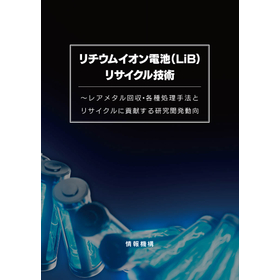
Geopolitical risks of rare metals, exit strategies for EVs... Recycling technology for lithium-ion batteries (LiB) is attracting attention against the backdrop of various issues!
★ Covers related regulations and business trends, recovery technologies for rare metals in batteries, various processing and safety measures in recycling, necessary analytical evaluation methods, and examples of material development contributing to recycling!
Inquire About This Product
basic information
Format: B5 size, 200 pages, ISBN 978-4-86502-285-8 Authors: 28 individuals
Price information
List price: 59,400 yen (including tax (10% consumption tax))
Price range
P2
Delivery Time
P1
※Orders placed by 3 PM will be shipped on the same day.
Applications/Examples of results
〇 Business Trends and Related Regulations - Movements of domestic and international companies related to minerals, automotive, battery manufacturers, etc., and industry responses to related regulations such as the 3R Law and Basel Convention. - Developments in EV battery recycling in Europe, China, and the United States. - Domestic and international battery production volumes, distribution status of used LiBs, and business potential. 〇 Rare Metal Recovery Technologies - Explanation of representative processing flows (direct recycling method, dry refining method, wet refining method), and the cost structure of recycling. - Separation and recovery technologies for nickel, cobalt, lithium, and fluorine, as well as physical sorting and elemental separation technologies. 〇 Processing Technologies for Safe Recycling - Environmentally friendly processing methods, recovery methods that do not damage electrode active materials, causes of fire accidents and countermeasures. 〇 Detection and Analysis Evaluation Technologies Necessary for Recycling - Battery detection in waste, impurity evaluation, concepts of purity, crystal structure analysis, organic matter analysis, various analytical methods and examples of analysis results for material property evaluation. 〇 Development of Materials Contributing to Recycling - Guidelines for binder design and elution methods, bio-adsorbents for rare metals, battery pack design considering safety and recycling efficiency, development of fluorine-free aqueous binders.
catalog(1)
Download All Catalogs
Company information

The information organization aims to contribute to industry development through technology seminars in fields such as chemistry, pharmaceuticals, electronics, machinery, environment, cosmetics, and food, as well as the publication of technical books, correspondence education courses, and DVDs that record seminars.
