Complete collection of 55 pages of illustrated case studies on underwater drone applications for bridges, dams, and waterways.

Visible in murky water and dark places: Examples of underwater inspections that do not rely solely on diving and the introduction of related products.
Our company prioritizes the safety of workers while conducting inspections and surveys of underwater structures, and we promote the use of underwater robots and drones as a means to achieve stable survey quality, shorten construction periods, and optimize costs. In sites such as bridge substructures, dam embankments, agricultural waterways, and distribution reservoirs, issues of safety and reproducibility often arise in traditional diving surveys due to murky water, dark conditions, and flowing currents. This document is organized around achievements and case studies to help assess "in which environments underwater drones are effective" and "what level of results can be expected" when introducing them to address these challenges. It is not just a product description; it specifically introduces survey methods, verification content, and implementation effects using actual site photos and sonar images. We use the FIFISH W6 MAX and E-MASTER NAVI for inspections, and by combining them with 2D imaging sonar and direct power supply systems, we achieve stable long-duration surveys even in murky water environments. This document can serve as practical reference material for those considering the feasibility of introducing underwater drones or reviewing survey methods.

Inquire About This Product
Related Videos
basic information
The underwater drone body is capable of omnidirectional movement with multiple thrusters, ensuring stable operability even in narrow spaces and near structures. It comes standard with a high-resolution camera and high-brightness LED lights, making it suitable for a wide range of environments from shallow to deep waters. By equipping a 2D imaging sonar, it can capture the shape of structures and erosion conditions in environments where optical cameras cannot see, such as murky water, dark places, and nighttime. The sonar screen can be checked in real-time, contributing to improved judgment and recording accuracy during investigations. Using a direct power supply system allows for long-term continuous inspections and surveys without the constraints of battery replacement. The acquired video and sonar data can be recorded and saved, and can be utilized for report creation and comparison of changes over time. The configuration is designed with a focus on immediate verification on-site and documentation for subsequent processes.
Price information
*Open price (varies by product, from 300,000 yen to over 10 million yen)
Delivery Time
Applications/Examples of results
This document introduces various case studies of underwater structures such as agricultural water channels, distribution reservoirs, aquaculture facilities, bridge substructures, and dam embankments. In agricultural water channels, sediment and damage assessments are conducted in a short time, minimizing water stoppage during investigations. In distribution reservoirs and aquaculture facilities, 2D imaging sonar is used even in turbid environments to understand the condition of walls and bottoms, serving as a basis for cleaning and repair plans. In the bridge sector, the scouring conditions around bridge piers are checked non-contact, reducing the risks associated with diving operations. Through these achievements, the capabilities of underwater drones in "usable sites" and "difficult conditions for application" have become clearer. This document also organizes the criteria for such judgments, making it useful as a reference for considerations before implementation.
catalog(1)
Download All Catalogs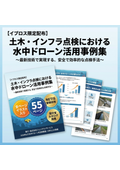
News about this product(1)
Company information

At Jun Techno Service, we provide inspection and photography services for aging infrastructure in civil engineering, addressing the global challenges of infrastructure deterioration and workforce shortages that have been overlooked for a long time. In an era where proper maintenance management is deemed crucial, we prioritize human life and promote the IT transformation of infrastructure inspection surveys using underwater autonomous robot cameras (underwater drones) to enable continuous and efficient inspections. We aim to create a long-term safe society in collaboration with the community and everyone involved. ◆ NETIS Registration: Conservation inspection technology for underwater installations using underwater autonomous robot cameras (underwater drones) KTK-210002-A Examples of utilizing underwater autonomous robot cameras (underwater drones): - Bridge pier inspections and regular checks - Maintenance management of dam facilities - Maintenance management of reservoirs - Management of treatment plants and pump stations - Marine research at universities - Investigation of watershed sewer pipelines - Observation of aquaculture growth conditions - Investigation within agricultural drainage channels - Investigation of pipelines in ozone contact tanks at water purification plants