

Explains the mechanisms of decision-making, judgment with biases, methods to prevent judgment errors, and introduces ways to change the behavior of others.
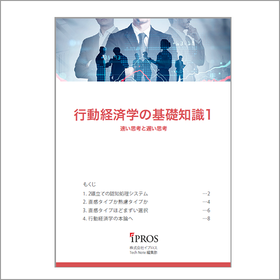
This document explains "behavioral economics," which incorporates insights from psychology into economics. It introduces the mechanisms by which people make judgments, an overview of rough judgments based on intuition known as "heuristics," methods to prevent judgment errors, and ways to change one's own and others' behaviors. 【Contents】 1. Fast Thinking and Slow Thinking 2. The Traps of Heuristics 3. The Mechanism of Self-Destructive Choices 4. How to Avoid Self-Destruction? 5. Behaviors Likely to Occur Under Risk 6. Do People Act Based on Material Goods? 7. Nudging Behavior in a Positive Direction *The document can be viewed immediately by downloading the catalog.
Inquire About This Product
basic information
【Table of Contents (Excerpt)】 ■ Two-System Cognitive Processing ■ Intuitive Type or Deliberative Type ■ Being Influenced by "Typicality" - The Heuristic of Representativeness ■ Examples of Judgment Errors Arising from the Heuristic of Representativeness ■ Being Influenced by "Salience" - The Heuristic of Availability ■ Being Influenced by Irrelevant Initial Values - Anchoring and Insufficient Adjustment ■ Being Influenced by "Immediate Concerns" - Present Bias ■ The Self-Destruction of "Ants" Planning and "Grasshoppers" Executing ■ Binding Future Self - Precommitment ■ Raising the Reference Point for Self-Control ■ Risk Attitudes Change Depending on the Framework - Framing Effect ■ Overestimating Small Probabilities - Overweighting ■ What is a Nudge? ■ The Effects of Nudging
Applications/Examples of results
-
catalog(1)
Download All Catalogs![Fundamentals of Behavioral Economics [All 10 Sessions]](https://image.www.ipros.com/public/catalog/image/01/c67/709533/IPROS16939147169400056426.jpeg?w=120&h=170)