1~21 item / All 21 items
Displayed results
Filter by category

Added to bookmarks
Bookmarks listBookmark has been removed
Bookmarks listYou can't add any more bookmarks
By registering as a member, you can increase the number of bookmarks you can save and organize them with labels.
Free membership registrationContact this company
Contact Us Online1~21 item / All 21 items
Filter by category

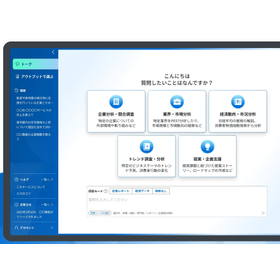
"NIKKEI KAI" is a professional-oriented generative AI service that creates "solutions" from reliable information. Using RAG technology, it generates answers from articles and data from highly reliable paid media, including the Nihon Keizai Shimbun, minimizing the risk of hallucination. RAG (Retrieval-Augmented Generation) is a technology that allows AI to reference external databases, enabling it to generate answers to a broader range of questions. 【Key Features】 ■ Automatically optimized questions provide appropriate answers even to vague inquiries ■ Mode switching allows for tailored use according to purpose, enhancing research with verified data ■ Generation of company lists based on specified criteria *For more details, please download the PDF or feel free to contact us.
Added to bookmarks
Bookmarks listBookmark has been removed
Bookmarks listYou can't add any more bookmarks
By registering as a member, you can increase the number of bookmarks you can save and organize them with labels.
Free membership registration
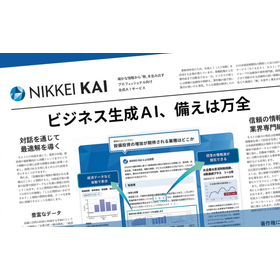
This article is a re-edited version of the corporate-oriented generative AI feature "NIKKEI KAI" published in the Nikkei Shimbun on April 16, 2025. We will introduce examples of high-precision information provision based on the latest economic data, as well as its use in strategic planning and proposal creation. An increasing number of companies are utilizing generative AI (artificial intelligence) to improve operational efficiency. While it can automate everything from information gathering to document creation, it is also true that its usability in business is hindered by issues related to the reliability, freshness, and copyright of the information. The solution to these challenges is the corporate-oriented generative AI service "NIKKEI KAI" developed by the Nikkei Inc. *For detailed content of the column, please refer to the related links. For more information, feel free to contact us.
Added to bookmarks
Bookmarks listBookmark has been removed
Bookmarks listYou can't add any more bookmarks
By registering as a member, you can increase the number of bookmarks you can save and organize them with labels.
Free membership registration
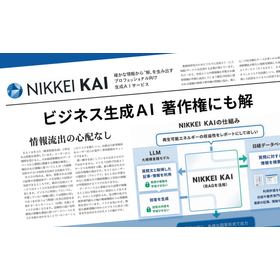
This article is a re-edited version of the corporate-focused generative AI feature "NIKKEI KAI" published in the Nikkei Newspaper on May 30, 2025. We will introduce the features and benefits of a new service that allows the use of the latest information while considering risks of information leakage and copyright issues. More companies are utilizing generative AI (artificial intelligence) services in their businesses. However, it is also true that many are hesitant to adopt these technologies due to concerns about confidential information being leaked as external information is learned by generative AI, as well as copyright issues. With the newly launched corporate generative AI service "NIKKEI KAI" from the Nikkei Inc., you can utilize the latest information in your business while avoiding such risks. *For detailed content of the column, please refer to the related link. For more information, feel free to contact us.
Added to bookmarks
Bookmarks listBookmark has been removed
Bookmarks listYou can't add any more bookmarks
By registering as a member, you can increase the number of bookmarks you can save and organize them with labels.
Free membership registration
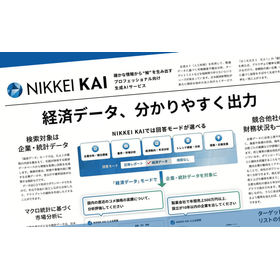
This article is a re-edited version of the feature on corporate generative AI "NIKKEI KAI" published in the Nikkei Shimbun on July 4, 2025. We will introduce a variety of functions and use cases, such as market analysis using economic data, corporate research, and target list creation. There is a growing demand to quickly create market research, competitive analysis, and target lists based on numerical data using generative AI (artificial intelligence). *For detailed content of the column, please refer to the related links. For more information, feel free to contact us.
Added to bookmarks
Bookmarks listBookmark has been removed
Bookmarks listYou can't add any more bookmarks
By registering as a member, you can increase the number of bookmarks you can save and organize them with labels.
Free membership registration
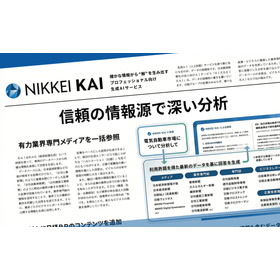
This article is a re-edited version of the corporate-focused generative AI "NIKKEI KAI" feature in the Nikkei Newspaper (August 4, 2025). We will introduce reliable information sources that provide deeper industry analysis and insights into the latest technologies and industry trends. KAI uses a technology called RAG (Retrieval-Augmented Generation) to generate responses by accurately referencing information from a dedicated database. *For detailed content of the column, please refer to the related links. For more information, feel free to contact us.
Added to bookmarks
Bookmarks listBookmark has been removed
Bookmarks listYou can't add any more bookmarks
By registering as a member, you can increase the number of bookmarks you can save and organize them with labels.
Free membership registration
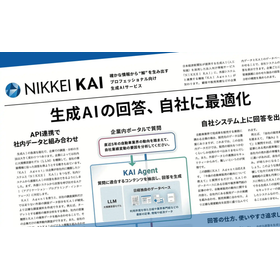
This article is a re-edited version of the feature on corporate generative AI "NIKKEI KAI" published in the Nikkei Shimbun on October 7, 2025. We would like to introduce "KAI Agent," which allows you to display KAI's responses directly from internal systems without sending data externally. With the rapid evolution of generative AI, the methods of research and analysis in companies are undergoing significant changes. Some companies are even building large language models (LLMs) internally to obtain responses tailored to their business environments. *For detailed content of the column, please refer to the related links. For more information, feel free to contact us.
Added to bookmarks
Bookmarks listBookmark has been removed
Bookmarks listYou can't add any more bookmarks
By registering as a member, you can increase the number of bookmarks you can save and organize them with labels.
Free membership registration
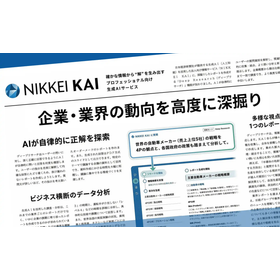
This article is a re-edited version of the corporate-focused generative AI "NIKKEI KAI" feature in the Nikkei Newspaper (November 17, 2025). This time, a "Deep Research" function has been added, allowing for the creation of in-depth reports on KAI. It enables comprehensive research from company overviews to competitive comparisons and industry overviews, assisting in more advanced management decisions. *For detailed content of the column, please refer to the related links. For more information, feel free to contact us.
Added to bookmarks
Bookmarks listBookmark has been removed
Bookmarks listYou can't add any more bookmarks
By registering as a member, you can increase the number of bookmarks you can save and organize them with labels.
Free membership registration
In the sales and research departments, a significant amount of time is often consumed by routine tasks such as document preparation, data organization, and report writing, which prevents sufficient resources from being allocated to the essential areas of "customer understanding" and "market analysis." As a solution to these challenges, the utilization of generative AI in business has recently garnered attention. By having AI handle tasks such as information organization, summarization, and document creation, individuals can focus on higher value-added activities like thinking and analysis. This article will introduce the mechanisms by which generative AI achieves business efficiency, practical use cases in sales and research departments, and important considerations for effective utilization. *For more detailed information, please refer to the related links. Feel free to contact us for further inquiries.*
Added to bookmarks
Bookmarks listBookmark has been removed
Bookmarks listYou can't add any more bookmarks
By registering as a member, you can increase the number of bookmarks you can save and organize them with labels.
Free membership registration
In research departments and planning positions, it is required to continuously create various types of documents such as reports, proposals, and presentation materials with high quality. These daily tasks can often become burdensome for business professionals. Amidst this, in recent years, the evolution of AI technology has significantly changed the way document creation is approached. AI is beginning to take on the role of a business partner in document creation tasks, supporting advanced information gathering and analysis, as well as idea generation. This article will provide specific benefits of utilizing AI for document creation, effective ways to leverage it, and hints for transforming business operations through AI utilization, aiming to achieve both "efficiency" and "quality improvement." *For more details on the column, please refer to the related links. For further inquiries, feel free to contact us.*
Added to bookmarks
Bookmarks listBookmark has been removed
Bookmarks listYou can't add any more bookmarks
By registering as a member, you can increase the number of bookmarks you can save and organize them with labels.
Free membership registration
As a person in charge of corporate management planning or business planning, many individuals face concerns such as "I don't know how to launch a new business," "I want to know effective procedures and frameworks," and "Is there a way to utilize AI to streamline planning?" In modern business, launching new ventures is essential for maintaining and growing a company's competitive edge. However, it is also true that new businesses have a low success rate, and many companies encounter challenges. This article will provide a detailed explanation of five processes that lead to the successful launch of new businesses, along with practical frameworks. Additionally, it will discuss methods for efficient new business development using AI tools. *For more details on the column, please refer to the related links. Feel free to contact us for more information.*
Added to bookmarks
Bookmarks listBookmark has been removed
Bookmarks listYou can't add any more bookmarks
By registering as a member, you can increase the number of bookmarks you can save and organize them with labels.
Free membership registration
In today's rapidly changing market environment, the question of "which business should we invest our limited management resources (people, goods, and money) in?" is one of the key challenges in corporate management. While it is essential to identify promising businesses and accelerate their growth, it is also necessary to make appropriate decisions to withdraw from businesses with high maintenance costs or uncertain futures. One method that has garnered attention for objectively evaluating business portfolios in formulating such management strategies is "PPM analysis (Product Portfolio Management)." This article will provide a detailed explanation of the basics of PPM analysis, specific methods, case studies of real companies, as well as points to enhance the accuracy of the analysis and efficiency methods using AI. *For more details on the column, please refer to the related links. Feel free to contact us for more information.
Added to bookmarks
Bookmarks listBookmark has been removed
Bookmarks listYou can't add any more bookmarks
By registering as a member, you can increase the number of bookmarks you can save and organize them with labels.
Free membership registration
In the field of marketing, daily decision-making has come to require more speed and accuracy than ever before. From considering new initiatives to reviewing existing ones, deriving optimal actions within limited resources has become a common concern for many marketers. In such a situation, it is crucial to clarify the criteria for judging the direction of initiatives and the prioritization of actions. A useful framework for this judgment axis is the "4P analysis," which supports the core of marketing strategy. The 4P analysis is essential as a fundamental framework for comprehensively understanding the market, competition, and customers to design effective strategies. This article systematically explains the basics of 4P analysis, practical steps for its application, and methods to enhance analytical accuracy and speed by incorporating AI. *For more details on the column, please refer to the related links. Feel free to contact us for more information.*
Added to bookmarks
Bookmarks listBookmark has been removed
Bookmarks listYou can't add any more bookmarks
By registering as a member, you can increase the number of bookmarks you can save and organize them with labels.
Free membership registration
In August 2025, reports emerged that the Nikkei and Asahi Shimbun filed a lawsuit against the American AI search company Perplexity for copyright infringement, creating a significant ripple effect in the business world. While the number of companies utilizing generative AI to efficiently create market research reports and presentation materials is increasing, concerns are also rising, such as, "Is it safe to use these generated products externally?" and "Is there a risk of being sued for copyright infringement?" What should we be cautious about to safely utilize generative AI? This article will provide a detailed explanation of the requirements that constitute copyright infringement, the copyright risks that companies face in practice, and specific countermeasures. *For more details on the column, please refer to the related links. For further inquiries, feel free to contact us.*
Added to bookmarks
Bookmarks listBookmark has been removed
Bookmarks listYou can't add any more bookmarks
By registering as a member, you can increase the number of bookmarks you can save and organize them with labels.
Free membership registration
In the rapidly changing landscape of market environments and technology, there is an increasing need for companies to regularly reassess the direction of their business strategies. On the other hand, many corporate planning personnel face challenges such as "spending too much time on competitive analysis and organizing their own strengths and weaknesses, making quick decision-making difficult" and "wanting to improve the accuracy of analysis but lacking the resources to collect and organize external environmental data." In this context, many companies are utilizing "SWOT analysis." By separating and organizing internal and external environments, it is a widely used framework that clarifies the issues that serve as the foundation for strategic consideration. This article will explain the basic structure of SWOT analysis, the benefits of analysis, practical steps, points for leveraging analysis results in management decisions, and methods for improving efficiency using AI. *For detailed content of the column, please refer to the related links. For more information, feel free to contact us.*
Added to bookmarks
Bookmarks listBookmark has been removed
Bookmarks listYou can't add any more bookmarks
By registering as a member, you can increase the number of bookmarks you can save and organize them with labels.
Free membership registration
When planning sales strategies and business plans, it is not uncommon to face questions such as, "Which market should we target?" "How should we differentiate ourselves from competitors?" and "How can we leverage our strengths?" One effective way to address these strategic planning challenges is through "3C analysis." The 3C analysis is a framework that analyzes the market environment based on the three elements of "Customer (market and customers)," "Competitor," and "Company." By comprehensively capturing the business from each perspective, you can identify the key elements necessary for success in the market. In this article, we will systematically explain 3C analysis, covering everything from an overview to specific practical steps, and effective ways to utilize it in sales strategies, incorporating examples of analysis, templates, and ideas for efficiency using AI. *For detailed content of the column, please refer to the related links. For more information, feel free to contact us.*
Added to bookmarks
Bookmarks listBookmark has been removed
Bookmarks listYou can't add any more bookmarks
By registering as a member, you can increase the number of bookmarks you can save and organize them with labels.
Free membership registration
In today's rapidly changing market and customer needs, it is essential to fully understand the impacts of macro external environments such as policy changes, economic trends, and technological innovations, and to flexibly review the direction of sales strategies and sales plans. However, many sales planning personnel may feel that "even if we want to quantitatively analyze external factors, it takes a tremendous amount of time to collect and organize information, making it difficult to balance with daily operations." One solution to these challenges that deserves attention is "PEST analysis," which serves as the foundation for strategic planning. This article will systematically explain the basic structure of PEST analysis, its objectives and benefits in sales planning, specific methods and case studies of utilization, as well as ideas for enhancing and streamlining analysis using AI. *For detailed content of the column, please refer to the related links. For more information, feel free to contact us.*
Added to bookmarks
Bookmarks listBookmark has been removed
Bookmarks listYou can't add any more bookmarks
By registering as a member, you can increase the number of bookmarks you can save and organize them with labels.
Free membership registration
The Five Forces Analysis (5F, 5Forces) refers to a framework that systematically analyzes the profitability and intensity of competition in an industry through five competitive factors, such as "the threat of new entrants" and "competition among existing companies." In recent years, as market environments change rapidly, strategic planning in corporate management has become increasingly difficult. Due to factors such as the acceleration of digitalization, intensification of global competition, and diversification of customer needs, it has become challenging to maintain a company's competitive advantage through traditional intuitive decision-making alone. This article comprehensively explains the Five Forces Analysis, which is essential for formulating management strategies, covering everything from the basic concepts to specific steps for practical application, industry-specific analysis examples, and efficient analytical methods utilizing AI, providing practical knowledge directly related to strategic planning. *For detailed content of the column, please refer to the related link. For more information, feel free to contact us.*
Added to bookmarks
Bookmarks listBookmark has been removed
Bookmarks listYou can't add any more bookmarks
By registering as a member, you can increase the number of bookmarks you can save and organize them with labels.
Free membership registration
The 4C analysis is a framework that analyzes four elements: Customer Value, Cost, Convenience, and Communication, aiming to differentiate from competitors and improve customer satisfaction by organizing and examining marketing strategies and measures from the customer's perspective. In today's complex market environment, where customer needs are diverse, the challenges faced by management planning, business planning, and marketing personnel are becoming increasingly serious. This article comprehensively explains the 4C analysis, covering its basic concepts, practical application procedures, case studies of real companies, and ideas for utilizing AI to enhance the accuracy and efficiency of the analysis, all in a practical manner. *For detailed content of the column, please refer to the related links. For more information, feel free to contact us.*
Added to bookmarks
Bookmarks listBookmark has been removed
Bookmarks listYou can't add any more bookmarks
By registering as a member, you can increase the number of bookmarks you can save and organize them with labels.
Free membership registration
A business plan is a blueprint that organizes the overall picture of a business and its future direction, clearly outlining the execution strategy. In today's rapidly changing market environment and technological landscape, the need for companies to regularly reassess their business strategy direction is increasing year by year. On the other hand, many business planning professionals face challenges such as "spending too much time on competitive analysis and self-analysis, making quick decision-making difficult" and "wanting to improve the accuracy of analysis but lacking the resources to collect and organize external environmental data." This article will explain the basic structure of a business plan, the steps for creating one, and the scenarios for its use, as well as how to use AI to streamline and enhance these tasks. *For detailed content of the column, please refer to the related links. For more information, feel free to contact us.*
Added to bookmarks
Bookmarks listBookmark has been removed
Bookmarks listYou can't add any more bookmarks
By registering as a member, you can increase the number of bookmarks you can save and organize them with labels.
Free membership registration
This document is a white paper for personnel in sales planning and consulting departments on how to effectively utilize generative AI in the creation of proposal materials. It explains what is required in sales planning in the era of widespread generative AI and the advantages of using generative AI in the creation of proposal materials. It also includes specific use cases such as quickly understanding client industries and gathering supporting information. We encourage you to use this as the first step in implementation. [Contents (partial)] ■ Introduction | Evolving proposals with the help of generative AI ■ What is required in sales planning in the era of widespread generative AI ■ Advantages of using generative AI in proposal creation ■ Specific use cases ■ Conclusion | Generative AI as a weapon to surpass competitors *For more details, please download the PDF or feel free to contact us.
Added to bookmarks
Bookmarks listBookmark has been removed
Bookmarks listYou can't add any more bookmarks
By registering as a member, you can increase the number of bookmarks you can save and organize them with labels.
Free membership registration
This document is a white paper introducing the approach to new business development utilizing generative AI. It explains the changes in the environment surrounding new businesses and the background of companies beginning to fully implement generative AI. The key points are organized based on actual use cases such as idea generation, targeting, and customer analysis. The content allows you to experience "reliable outputs" that enhance business productivity. [Contents] ■ Why should we engage in new business now? ■ What has changed with the advent of generative AI? ■ How generative AI and business data are changing the approach to new business development ■ Summary | The new norms of "new business" transformed by generative AI *For more details, please download the PDF or feel free to contact us.
Added to bookmarks
Bookmarks listBookmark has been removed
Bookmarks listYou can't add any more bookmarks
By registering as a member, you can increase the number of bookmarks you can save and organize them with labels.
Free membership registration