1~6 item / All 6 items
Displayed results

Added to bookmarks
Bookmarks listBookmark has been removed
Bookmarks listYou can't add any more bookmarks
By registering as a member, you can increase the number of bookmarks you can save and organize them with labels.
Free membership registration
Contact this company
Contact Us OnlineBefore making an inquiry
Download PDF1~6 item / All 6 items

The global situation is changing rapidly, and it is having a significant impact on the solar power generation system market. The "Solar Power Overseas Market Report" outlines the current state of the solar power generation system market and industry in 31 countries and regions worldwide, including major overseas markets and emerging countries expected to see future growth. It covers the market size of solar power generation systems, support measures for dissemination, project status, future prospects, and also explains the trends in international trade friction and supply chains that affect the supply and demand of solar cells. *For more details, please download the PDF (catalog) or feel free to contact us.*
Added to bookmarks
Bookmarks listBookmark has been removed
Bookmarks listYou can't add any more bookmarks
By registering as a member, you can increase the number of bookmarks you can save and organize them with labels.
Free membership registration
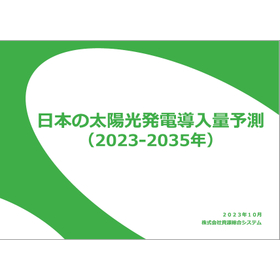
The "Energy Supply Resilience Act" and the "Revised Global Warming Countermeasures Promotion Act" have been enacted, accelerating efforts in energy and environmental policies towards achieving a 46% reduction in greenhouse gases by 2030. The government has established a "Basic Policy for Realizing GX (Green Transformation)," clearly stating the goal of achieving a power generation ratio of 36-38% from renewable energy sources by 2030, which has now become a mandatory target, previously considered ambitious in the Basic Energy Plan. On the demand side, there is an increase in electricity demand due to the recovery from the COVID-19 pandemic, and the desire to introduce solar power has risen as a response to the soaring energy prices and electricity rates triggered by Russia's invasion of Ukraine. The use of renewable energy for SDGs and enhancing corporate value is expanding throughout the supply chains of major domestic companies. The introduction ratio is expected to increase with the shift from the FIT system to self-consumption models, PPA models, and the FIP system. This document looks ahead to the next decade, analyzing price forecasts, changes in social environments, market changes, and technological advancements from two scenarios: the "Current Growth Case," which aims to achieve the 2030 introduction target, and the "Acceleration Case," where the introduction environment significantly improves and progresses. It predicts the amount of solar power installation by application and scale.
Added to bookmarks
Bookmarks listBookmark has been removed
Bookmarks listYou can't add any more bookmarks
By registering as a member, you can increase the number of bookmarks you can save and organize them with labels.
Free membership registration
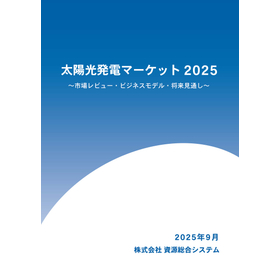
"The Solar Power Market 2025: Market Review, Business Models, and Future Outlook" is a comprehensive research report that analyzes the solar power market globally and in Japan. It provides an overview of market size, technological innovations, policy and institutional changes, and shifts in business models, clarifying future growth opportunities and business risks. In 2024, the annual global installation volume is expected to reach 602 GW, a 32% increase from the previous year, with cumulative installations surpassing 2 TW in just two years. In Japan, efforts toward achieving GX (Green Transformation) are accelerating through the formulation of the "7th Basic Energy Plan" and the "Next-Generation Solar Cell Strategy" by both the public and private sectors. This report systematically organizes the latest trends in policies and institutions, technological innovations, changes in industrial structure, and the diversification of business models. It also provides a broad explanation of new market prospects, including corporate PPAs, self-consumption markets, mixed-use of agricultural land, water surfaces, and parking lots, as well as BIPV and lightweight solar cells. This definitive guide is essential for strategic planning, market development, and business construction in solar power-related enterprises. *For more details, please download the PDF (catalog) or feel free to contact us.*
Added to bookmarks
Bookmarks listBookmark has been removed
Bookmarks listYou can't add any more bookmarks
By registering as a member, you can increase the number of bookmarks you can save and organize them with labels.
Free membership registration
This report is a practical guide that comprehensively covers the latest business trends in solar power generation and energy storage batteries, taking into account structural changes in the market, policies, and technology. It organizes the solar power generation installation targets based on the "7th Basic Energy Plan," along with the efforts of the government and ministries that support it. Additionally, it clarifies the challenges of expanding installations and strategies to overcome them, considering changes in systems and markets, and proposes directions for future business opportunities based on advanced case studies and policy trends. *For more details, please download the PDF (catalog) or feel free to contact us.*
Added to bookmarks
Bookmarks listBookmark has been removed
Bookmarks listYou can't add any more bookmarks
By registering as a member, you can increase the number of bookmarks you can save and organize them with labels.
Free membership registration
In the "7th Basic Energy Plan," the national goal of achieving a solar power generation ratio of 23-29% by the fiscal year 2040 has been set, and efforts to make renewable energy a primary power source are accelerating in conjunction with the "GX (Green Transformation) Promotion Strategy" and the "Global Warming Countermeasures Plan." The government is collaborating with the Ministry of Economy, Trade and Industry, the Ministry of the Environment, the Ministry of Land, Infrastructure, Transport and Tourism, the Ministry of Agriculture, Forestry and Fisheries, the Tokyo Metropolitan Police Department, and municipalities across the country to promote multifaceted measures aimed at ensuring stable power supply, improving economic rationality, and expanding decarbonized power sources, each fulfilling their respective roles. This document organizes and introduces a wide range of policy initiatives, including the promotion of rooftop, ground-mounted, and next-generation solar cells, the expansion of transmission networks, the development of storage systems, the expansion of solar power generation through coexistence with agricultural land, the promotion of practical applications for perovskite solar cells, measures to prevent metal theft, the establishment of systems to foster cooperation with local communities, and medium- to long-term responses to waste panels, along with an overview of the 2025 fiscal budget, in a clear manner categorized by each ministry and municipality.
Added to bookmarks
Bookmarks listBookmark has been removed
Bookmarks listYou can't add any more bookmarks
By registering as a member, you can increase the number of bookmarks you can save and organize them with labels.
Free membership registration
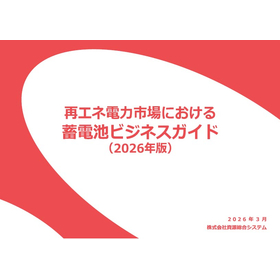
As the adoption of renewable energy progresses, the role of grid-scale batteries is becoming increasingly important. This document comprehensively covers essential information needed for renewable energy power market business utilizing batteries and explains it in an easy-to-understand manner. It details specific utilization methods for grid-scale batteries and market trends, including the capacity market, demand-supply adjustment market, wholesale electricity market, and battery storage market associated with power generation facilities, providing the latest information on each market. Furthermore, it touches on government policies and subsidy information, clearly indicating future business opportunities. Additionally, it addresses battery technology and trends among major suppliers, predicting future market developments. With a wealth of terminology explanations included, this serves as a practical business guide for those looking to enter the battery business.
Added to bookmarks
Bookmarks listBookmark has been removed
Bookmarks listYou can't add any more bookmarks
By registering as a member, you can increase the number of bookmarks you can save and organize them with labels.
Free membership registration