1~11 item / All 11 items
Displayed results

Added to bookmarks
Bookmarks listBookmark has been removed
Bookmarks listYou can't add any more bookmarks
By registering as a member, you can increase the number of bookmarks you can save and organize them with labels.
Free membership registration
Contact this company
Contact Us Online1~11 item / All 11 items
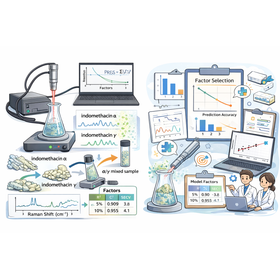
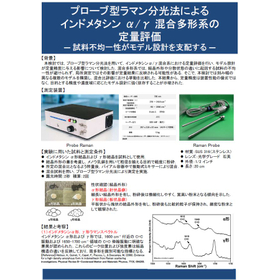
In this study, we conducted a quantitative evaluation of the indomethacin α/γ mixed system using probe-type Raman spectroscopy and examined the impact of model design on quantitative accuracy. In mixed polymorphic systems, the heterogeneity of samples due to differences in crystal morphology and dispersion state is unavoidable, and local measurements may reflect this influence in the quantitative results. Therefore, we constructed multiple models with different step widths and compared their behaviors in the evaluation of mixing ratios. The results suggest that quantitative accuracy strongly depends on model design tailored to the desired precision and concentration range, rather than the performance of the equipment itself.
Added to bookmarks
Bookmarks listBookmark has been removed
Bookmarks listYou can't add any more bookmarks
By registering as a member, you can increase the number of bookmarks you can save and organize them with labels.
Free membership registration
In this study, we conducted a quantitative evaluation of the indomethacin α/γ polymorphic mixed system using probe-type Raman spectroscopy. In mixed polymorphic systems, sample heterogeneity due to differences in crystal morphology and dispersion state is unavoidable, and in Raman spectroscopy, which involves local measurements, this can manifest as variability in quantitative values. In this study, we constructed multiple quantitative models with different sampling conditions and compared factor number dependency (PRESS) and quantitative performance indicators (R², SEC, SECV). As a result, it became clear that quantitative accuracy strongly depends not on differences in instrument performance, but on model design tailored to the desired accuracy and concentration range. This case illustrates that in the quantitative evaluation of crystalline polymorphs using probe-type Raman spectroscopy, it is not a matter of "whether it can be measured," but rather "how to design the model" that governs the results. Tech Analysis Co., Ltd. provides practical support that includes not only the optimization of measurement conditions but also analysis design and model construction.
Added to bookmarks
Bookmarks listBookmark has been removed
Bookmarks listYou can't add any more bookmarks
By registering as a member, you can increase the number of bookmarks you can save and organize them with labels.
Free membership registration
At the JASIS 2024 "New Technology Presentation," we presented a case study titled "Analysis of Moisture-Proof Packaging for Pharmaceuticals Using Raman Spectroscopy" in collaboration with Tech Analysis Co., Ltd. We introduced a case where model formulations packaged in a humidity-controlled environment were set up, and the physical property changes of the model formulations were analyzed and evaluated in real-time using Raman spectroscopy.
Added to bookmarks
Bookmarks listBookmark has been removed
Bookmarks listYou can't add any more bookmarks
By registering as a member, you can increase the number of bookmarks you can save and organize them with labels.
Free membership registration
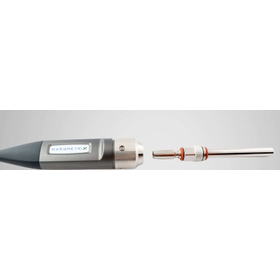
• Accurate and reproducible measurements are possible • Disposable probes for batch use in case of high cost • Can be sterilized by autoclave, SIP, EtO, or gamma radiation • Compatible with standard Pg13.5 ports • Specifications such as probe length can be customized
Added to bookmarks
Bookmarks listBookmark has been removed
Bookmarks listYou can't add any more bookmarks
By registering as a member, you can increase the number of bookmarks you can save and organize them with labels.
Free membership registration
In the pharmaceutical industry, there are active pharmaceutical ingredients with multiple crystal structures, which are said to influence various physicochemical properties such as solubility, depending on the intellectual property rights of the drug and polymorphism. Furthermore, it is known to affect the bioavailability of drugs, making it one of the most important tasks for originator, generic, and pharmaceutical companies, with crystal forms and impurities often selected as Critical Quality Attributes (CQA). In industrial crystallization, the goal is to separate impurities and control the crystal structure and particle size distribution of the product crystals. However, many phenomena related to crystallization remain unclear, despite the use and investigation of inline analytical techniques such as FBRM, FT-IR, near-infrared, and Raman spectroscopy. Raman spectroscopy is known to have a clear advantage over other inline analytical techniques in that it can quantitatively operate crystal transitions. This paper presents the practical applicability and usefulness of low-frequency Raman spectroscopy by equipping a Raman spectrometer with a low-frequency Raman module, which has recently been commercialized and enables measurement of low-frequency Raman spectra, and conducting real-time observation of crystal transitions using CBZIII form as a model formulation.
Added to bookmarks
Bookmarks listBookmark has been removed
Bookmarks listYou can't add any more bookmarks
By registering as a member, you can increase the number of bookmarks you can save and organize them with labels.
Free membership registration
The stability testing guidelines state that stability tests, which determine the shelf life of formulations and storage conditions for pharmaceuticals under various environmental factors such as temperature, humidity, and light, are necessary tests for drug approval applications. Therefore, using Raman spectroscopy, which allows for non-contact measurements and is used for identifying polymorphs similar to powder X-ray diffraction, we focused on one of the environmental factors, "humidity," and analyzed and evaluated the crystal transition from hydrate to anhydrous form of caffeine under humidification conditions of a model formulation using Raman spectra, demonstrating that Raman spectroscopy is effective for observing the crystal form of active pharmaceutical ingredients under humidification conditions.
Added to bookmarks
Bookmarks listBookmark has been removed
Bookmarks listYou can't add any more bookmarks
By registering as a member, you can increase the number of bookmarks you can save and organize them with labels.
Free membership registration
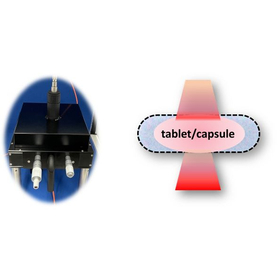
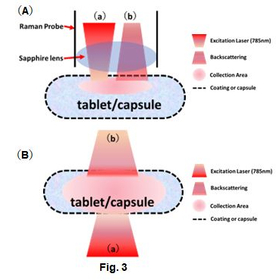
In the analysis of pharmaceutical tablets and capsules, it can be difficult to easily obtain information about the physical state and components of the active pharmaceutical ingredient inside the tablet or capsule due to interference from the tablet coating or capsule material. In this study, commercially available drugs with coatings and capsules filled with active pharmaceutical ingredients of different raw materials were used as model formulations. By employing forward scattering (transmission) Raman spectroscopy, we demonstrate that it is possible to reduce surface interference caused by the coating of the tablet or capsule and to analyze and evaluate the components.
Added to bookmarks
Bookmarks listBookmark has been removed
Bookmarks listYou can't add any more bookmarks
By registering as a member, you can increase the number of bookmarks you can save and organize them with labels.
Free membership registration
A newly developed forward scattering (transmission) unit was connected to an existing Raman spectrometer, and using model formulations, the practicality and usefulness of the forward scattering unit were demonstrated. The forward scattering unit (manufactured by Horiba, Kyoto) is connected to the ALL-IN-ONE (Marqmetrix, Seattle, USA) Raman spectrometer via fiber. The measurement conditions included a spectral resolution of 6 cm-1, an excitation laser wavelength of 785 nm, a single accumulation, and an exposure time of 3 seconds. The sample can be simply placed on the standard sample stage, eliminating the need for adjustments in sample position or height. The company also provides holders compatible with different dosage forms, including glass containers and powdered samples, in addition to the tablets and capsules used in this study. In this experiment, the forward scattering unit was connected to the Marqmetrix ALL-IN-ONE for sample measurement; however, it can be connected and utilized with any Raman spectrometer that has fiber connection ports for the excitation laser and Raman scattered light (for example, Raman spectrometers manufactured by Wasatch Photonics).
Added to bookmarks
Bookmarks listBookmark has been removed
Bookmarks listYou can't add any more bookmarks
By registering as a member, you can increase the number of bookmarks you can save and organize them with labels.
Free membership registration
In May 2014, Japan's membership in PIC/S was approved, leading to the consideration of operational verification tests for all pharmaceutical raw materials used in formulations as required by PIC/S. Furthermore, in 2019, the Raman spectroscopy measurement method was included in the seventeenth revision of the Japanese Pharmacopoeia, second supplement, increasing expectations for Raman spectroscopy. It has become a widely used analytical method, ranging from the evaluation of the crystal forms of active pharmaceutical ingredients and research and development of crystallization reactions to quality control such as the assessment of content uniformity of active ingredients in formulations and raw material acceptance testing. As its use has expanded, issues have also emerged, such as the spectral tilting of substances with fluorescence, including cellulose and herbal raw materials. In recent years, cases of counterfeit pharmaceuticals have come to light, raising questions about the scientific validation of testing methods and the minimization of human errors in pharmaceutical quality control. Therefore, using crystalline cellulose with fluorescence as a model raw material, we report the results of constructing a discrimination model using a portable Raman spectrometer and scientifically validating the variability of the discrimination model and test results.
Added to bookmarks
Bookmarks listBookmark has been removed
Bookmarks listYou can't add any more bookmarks
By registering as a member, you can increase the number of bookmarks you can save and organize them with labels.
Free membership registration
By using this sample chamber, you can easily set up tablet and liquid samples in containers, and you can adjust the laser focus and measurement location in real-time while keeping it shielded using the probe position adjustment knob. By using the coarse and fine adjustment knobs, you can quickly and accurately move the measurement and probe.
Added to bookmarks
Bookmarks listBookmark has been removed
Bookmarks listYou can't add any more bookmarks
By registering as a member, you can increase the number of bookmarks you can save and organize them with labels.
Free membership registration
The TH-RamanProbe system consists of a control unit made up of a laser light source and power supply, and a probe that irradiates the sample with laser light and receives Raman scattered light from the sample. A special notch filter that cuts the excitation laser is built into the probe section. The probe, equipped with a sapphire lens that has high throughput, is available in two types: short focus and long focus, depending on the measurement purpose.
Added to bookmarks
Bookmarks listBookmark has been removed
Bookmarks listYou can't add any more bookmarks
By registering as a member, you can increase the number of bookmarks you can save and organize them with labels.
Free membership registration